Dr Faustus
Roxburgh Hall Theatre, BUCKINGHAM, MK18 5EH
Monday 7th December 2026
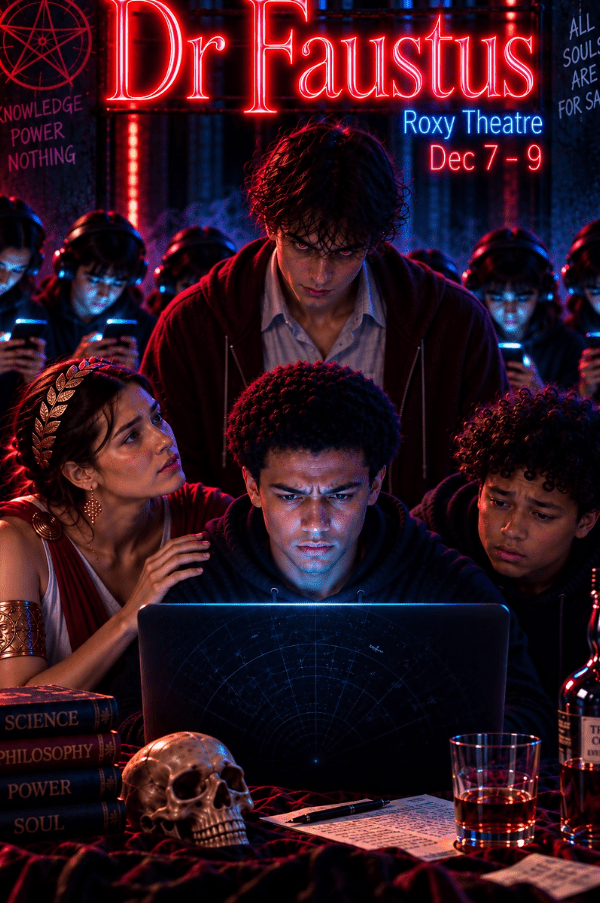
This adaptation reimagines Doctor Faustus for a contemporary audience,
relocating the action from Renaissance Germany to the world of modern
academia, technology and existential crisis. At its centre is John, a brilliant young
astrophysicist whose relentless pursuit of knowledge has led him beyond the limits
of science, philosophy and artificial intelligence towards the final forbidden
experiment: necromancy.
Framed by an apparent overdose and the final electrical storms of a dying brain,
the production explores the possibility that Faustus’s journey may be a
supernatural reality, a psychedelic vision, or the fragmented consciousness of a
man confronting his own mortality. The central question remains the same as in
Marlowe’s original: what happens when human intellect attempts to exceed the
boundaries of humanity itself?
Stylistically, the production combines elements of physical theatre, ensemble
storytelling and multimedia performance, drawing inspiration from the work of
companies such as Frantic Assembly, Complicité and the visual dynamism of
contemporary immersive theatre. The cast functions as a collective hive of spirits,
memories and manifestations of John’s subconscious, continually transforming to
create locations, ideas and psychological states.
Film, projection and live performance exist simultaneously, allowing internal
thought, memory and cosmic imagery to inhabit the same theatrical space.
Scientific imagery, astronomical phenomena and digital landscapes merge with
religious iconography and Renaissance themes to create a world where theology,
cosmology and technology collide.
Movement is central to the storytelling. Choreographed ensemble sequences
replace traditional scene changes, creating a fluid and dreamlike theatrical
language in which bodies become environments, forces and metaphysical entities.
Puppetry and visual metaphor further blur the boundary between reality and
hallucination.
Musically, the production embraces an electronic and cinematic soundscape,
reflecting both the scale of the universe John seeks to understand and the
overwhelming intensity of his psychological journey.
While radically reimagined in form and setting, this adaptation remains faithful to
the spirit of Marlowe’s tragedy. It preserves the play’s enduring themes of ambition,
hubris, temptation and the terrible cost of seeking absolute knowledge
Price
Ticket price
£0.00
