Book Launch - Foucault and Ulster: Loyalism at the end of Empire?
Peter Froggat Centre, Belfast, BT7 1PS
Wednesday 9th December 2026 7:00PM
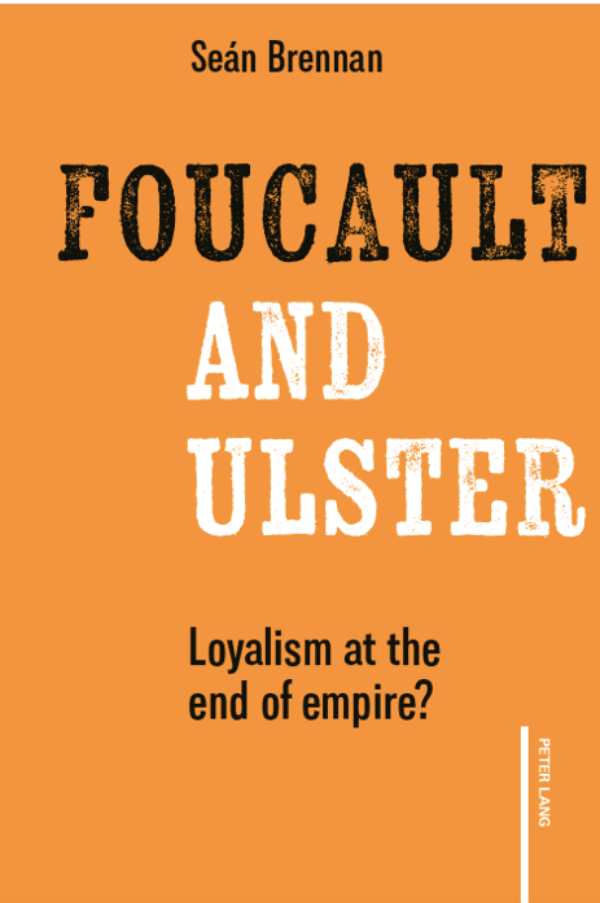
Ulster loyalism is generally enunciated as a violent 1970s white
British working-class response to political reform in Ireland.
However, at the end of empire, this idea of loyalism is now
understood to be much more complex and multi-faceted, a
dynamic phenomenon with several distinct strands interwoven
with the equally diverse ideological position we call patriotism.
Observed within a becoming theory of civil war this dynamic
phenomenon is critiqued through the oeuvre of French
philosopher Michel Foucault to reveal the violent power struggle
in Northern Ireland may not be between Ulster loyalists and
the Irish otheneion but, instead, a war within the family, a
ta emphylia, between the English loyalist human beings whose
work is of the soul and the rhizomatic loyalist whose work is of
the body. Observed through a Foucauldian logic, less travelled,
this idea of loyalism is biopolitically critiqued to unearth the
underlying causes of violence driving loyalism, and patriotism.
Rationalized by the transformation of sovereign power, through
blood, from the sovereign with his sword, in the sixteenth
century, to the citizen with her ‘rights’, in the twentieth century,
and onto the body with its code, in the twenty-first century,
Foucauldian insights arise on how the global ‘family’ might
overcome these beings whose work is of the soul, in accordance
with the neoliberal logos, to ensure the Human race can be what
it should be, alive.
Seán Brennan, an independent researcher, has worked in a
range of community education and community peacebuilding
initiatives in Northern Ireland since the 1980s. His doctoral
thesis, Ulster’s uncertain menders? The challenge of reintegration
and reconciliation for Ulster loyalists in a post-ceasefire society
was awarded the 2018 Basil Chubb Prize, by the Political Studies
Association of Ireland, for the Best PhD in Political Science 2017.
Event Details
Starts at 7:00PM
