2026-7 Season - Concert 4: Brahms, Clara Schumann and Dvorak
West Road Concert Hall, Cambridge, CB3 9DP
Saturday 13th March 2027 7:30PM
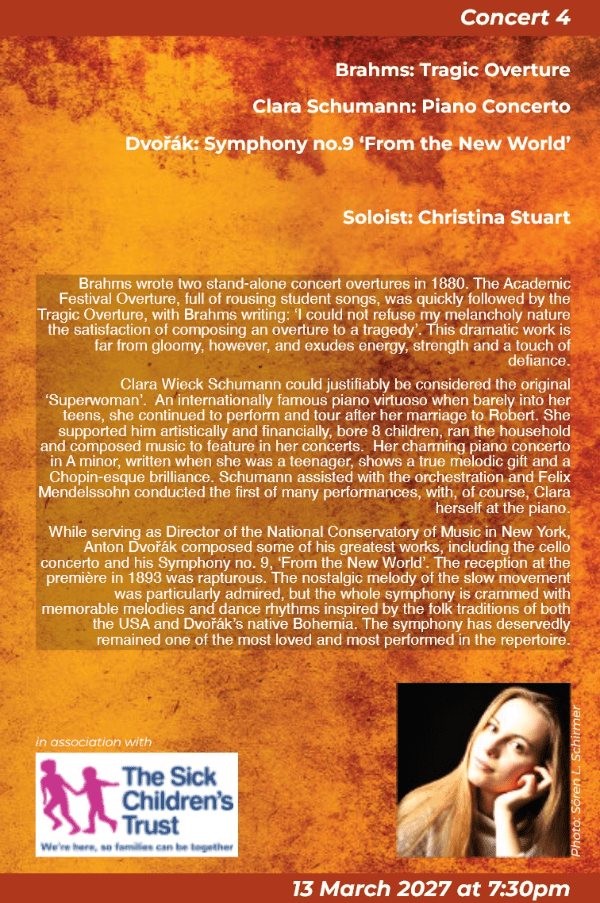
Brahms: Tragic Overture
Clara Schumann: Piano Concerto
Dvorak: Symphony No. 9
City of Cambridge Symphony Orchestra
Conductor: Robert Hodge
Soloist: Christina Stuart
Brahms wrote two stand-alone concert overtures in 1880. The Academic Festival Overture, full of rousing student songs, was quickly followed by the Tragic Overture, with Brahms writing: ‘I could not refuse my melancholy nature the satisfaction of composing an overture to a tragedy’. This dramatic work is far from gloomy, however, and exudes energy, strength and a touch of defiance.
Clara Wieck Schumann could justifiably be considered the original ‘Superwoman’. An internationally famous piano virtuoso when barely into her teens, she continued to perform and tour after her marriage to Robert. She supported him artistically and financially, bore 8 children, ran the household and composed music to feature in her concerts. Her charming piano concerto in A minor, written when she was a teenager, shows a true melodic gift and a Chopin-esque brilliance. Schumann assisted with the orchestration and Felix Mendelssohn conducted the first of many performances, with, of course, Clara herself at the piano.
While serving as Director of the National Conservatory of Music in New York, Anton Dvořák composed some of his greatest works, including the cello concerto and his Symphony no. 9, ‘From the New World’. The reception at the première in 1893 was rapturous. The nostalgic melody of the slow movement was particularly admired, but the whole symphony is crammed with memorable melodies and dance rhythms inspired by the folk traditions of both the USA and Dvořák’s native Bohemia. The symphony has deservedly remained one of the most loved and most performed in the repertoire.
Reserved seating planClara Schumann: Piano Concerto
Dvorak: Symphony No. 9
City of Cambridge Symphony Orchestra
Conductor: Robert Hodge
Soloist: Christina Stuart
Brahms wrote two stand-alone concert overtures in 1880. The Academic Festival Overture, full of rousing student songs, was quickly followed by the Tragic Overture, with Brahms writing: ‘I could not refuse my melancholy nature the satisfaction of composing an overture to a tragedy’. This dramatic work is far from gloomy, however, and exudes energy, strength and a touch of defiance.
Clara Wieck Schumann could justifiably be considered the original ‘Superwoman’. An internationally famous piano virtuoso when barely into her teens, she continued to perform and tour after her marriage to Robert. She supported him artistically and financially, bore 8 children, ran the household and composed music to feature in her concerts. Her charming piano concerto in A minor, written when she was a teenager, shows a true melodic gift and a Chopin-esque brilliance. Schumann assisted with the orchestration and Felix Mendelssohn conducted the first of many performances, with, of course, Clara herself at the piano.
While serving as Director of the National Conservatory of Music in New York, Anton Dvořák composed some of his greatest works, including the cello concerto and his Symphony no. 9, ‘From the New World’. The reception at the première in 1893 was rapturous. The nostalgic melody of the slow movement was particularly admired, but the whole symphony is crammed with memorable melodies and dance rhythms inspired by the folk traditions of both the USA and Dvořák’s native Bohemia. The symphony has deservedly remained one of the most loved and most performed in the repertoire.
Event Details
Starts at 7:30PM
